
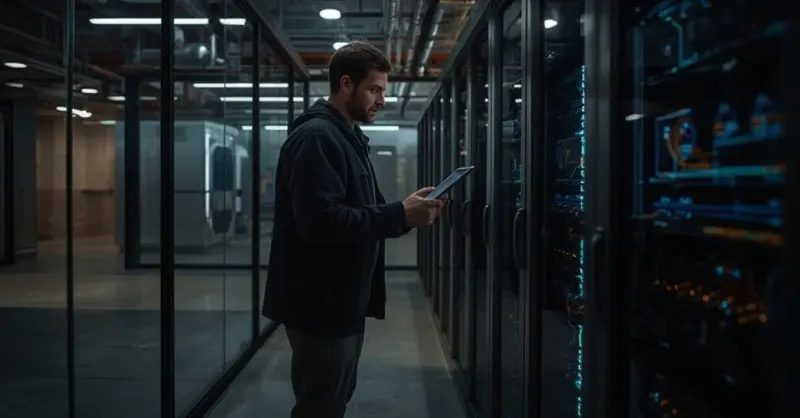
- Cloud Failover boundaries keep process authority on validated local control systems.
- Google Cloud Run and Compute Engine restore telemetry without seizing equipment control.
Table of Contents
Cloud Failover Is a Boundary Problem, Not an Availability Feature
A published uptime percentage tells you almost nothing about whether your refrigeration alarms survive a regional outage. The number describes a provider’s historical service posture across a shared fleet. It does not describe your recovery design, your event integrity, or who holds authority when a plant loses its monitoring feed at 2:00 AM on a Sunday.
I treat Cloud Failover as a boundary engineering discipline. Validated local control systems keep process authority over compressors, condensers, and defrost cycles. Cloud services carry telemetry, alerting, dashboards, and the operational coordination that lets a facilities team act on what the equipment reports. That boundary decides everything downstream.
Buyers discover the gap during a live cutover. Alarm timestamps collapse into a single ingestion time. Duplicate notifications reach plant personnel from two regions at once. Outbound connections nobody inventoried surface in a network log after the fact. No written failover authority exists between facilities engineering and central IT, so two teams wait on each other while a temperature excursion runs.
The geographic framing needs correcting up front. The Camden County NJ phrase is the supplied search driver for keyword mapping in this cluster. Lehigh County PA is the operational market where I place buyer context. Those two counties do not share one operating footprint, and I will not imply otherwise. The design vocabulary follows the Google Cloud Architecture Center disaster recovery guidance and the contingency planning structure published by NIST.
- Google Cloud Run: hosts stateless monitoring and alerting services across selected regions with managed scaling behavior.
- Compute Engine: carries VM-bound workloads through documented instance templates, recovery dependencies, and startup order.
- Web Application Firewall: restricts inbound application traffic to approved routes at the application edge.
- Egress Governance: constrains outbound traffic through an approved destination inventory enforced by workload identity.
How should refrigeration teams separate cloud failover from process control?
Keep process authority on validated local control systems. Cloud failover then restores supporting services without ever seizing control authority over equipment behavior. That single rule resolves most of the ambiguity that stalls a recovery design review, because it tells every stakeholder which system answers to which question when a region goes dark.
- Google Cloud Run: deploy stateless monitoring APIs across selected regions with independent service revisions.
- Compute Engine: document instance templates, recovery dependencies, and startup order before any exercise.
- Web Application Firewall: restrict inbound application traffic to approved routes tied to a named policy.
- Egress Governance: allowlist destinations required for telemetry ingestion and recovery operations.
In Lehigh County PA, the ownership gap between facilities engineering and central IT is where these designs fail first. Alarm ownership and escalation order belong in the written design before anyone schedules an exercise. I have watched two capable teams each assume the other held the paging rotation during a test, which turned a controlled drill into a forty-minute silence.
Which health checks should trigger cloud failover for refrigeration telemetry?
A readiness endpoint returns success only when required application dependencies are available, which separates application readiness from the load-balancer health check that decides traffic eligibility. That distinction protects event integrity, because a service can accept traffic while its telemetry pipeline still lags behind the equipment it monitors.
- Readiness endpoint: gate success on dependency availability across database, queue, and downstream API checks.
- Event timestamp: preserve source time and ingestion time as two distinct fields on every payload.
- Duplicate handling: key processing on stable event identifiers to make replay safe across regions.
- Web Application Firewall: apply documented rules to every exposed application endpoint.
The mechanism reference sits in the Cloud Run health check and failover configuration documentation. Regional routing on Google Cloud Run supports application availability across zones. Alarm correctness gets validated independently, because a healthy endpoint says nothing about whether the reading it just accepted reflects the compressor state five minutes ago.
Traffic eligibility and data freshness answer different questions. A load balancer routes requests to a service that can respond. A readiness check confirms the service can respond with trustworthy data. Teams that collapse those two checks into one endpoint end up routing traffic to a service that is technically alive and operationally blind.
What race conditions can corrupt refrigeration alerts during failover?
A naive cutover lets both regions process the same alarm, or delivers a delayed event after a newer reading has already landed. Define event identity, ordering rules, and one authoritative processor before enabling automated recovery. That sequence removes the race condition at its source instead of patching symptoms after the first duplicate page fires.
Stale-data detection deserves its own gate. I test it with recorded telemetry replayed through controlled fault injection, which surfaces the exact moment a delayed payload arrives behind a fresher one. Duplicate suppression gets the same treatment, because a suppression rule that works in staging can fail when two regions share a queue and neither owns the deduplication window.
Alert lineage matters as much as alert delivery. Every notification should trace back to a source event identifier, a source timestamp, and the processor that emitted it. When a plant operator asks why a defrost alarm arrived twice, the answer should come from a log record rather than a reconstruction of what probably happened.
One rejected design from a field diagnostic allowed dual-region alarm processing for apparent redundancy. We disallowed it once we traced how two processors would each emit a page for the same excursion. The local control system stays authoritative for equipment behavior, and the cloud layer coordinates the humans who respond to it.
I have spent 17 years building cloud and database resilience across LATAM and Tri-State enterprise deployments, and the pattern holds: the operator must hold its own IAM policies, destination inventory, and first-party telemetry pipeline. Renting that control from a wrapper leaves you negotiating for access to your own incident record.
When should refrigeration monitoring use Cloud Run or Compute Engine?
Choose the compute model by workload state, recovery dependencies, and operational ownership. Google Cloud Run fits stateless application services with regional deployment and managed scaling. Compute Engine fits workloads that require virtual machines and explicit instance recovery procedures. Either path needs tested data recovery, access controls, and documented failover authority before production release.
| Requirement | Architectural fit |
|---|---|
| Stateless telemetry API | Google Cloud Run |
| VM-specific software or operating requirements | Compute Engine |
| Inbound request filtering | Web Application Firewall |
| Controlled outbound destinations | Egress Governance |
Set recovery objectives from a business impact analysis that your facilities and IT owners actually signed. Record the real recovery time and the real data loss during each exercise. Provider availability figures describe a shared fleet, so deriving your acceptance criteria from them leaves you measuring someone else’s system.
Facilities and IT owners approve alarm behavior, manual operating procedures, and failback criteria before production release. That sign-off closes the loop between the people who understand the equipment and the people who hold the cloud tenancy. Skip it and the first real incident becomes the first real test.
A Lehigh County Refrigeration Monitoring Rebuild and Its Acceptance Gates
This is an NDA-anonymized field diagnostic and reference architecture with pre-release acceptance baselines. It is not a claim of measured production improvement. Client identity stays withheld, and every numerical recovery target comes from the client’s own business impact analysis rather than a figure I invented for this write-up.
The engagement pattern involves a Lehigh County PA industrial operator with refrigeration-dependent facilities, an internal facilities function, and centralized IT oversight. Monitoring data, service alerts, and recovery ownership were split across facility systems and cloud applications. Process control stayed inside the validated local control environment throughout the review.
Diagnosis surfaced stale telemetry exposure, duplicate alarms during restoration, unclear failover authority, untracked outbound connections, and dependence on a single application region. The rebuild placed Google Cloud Run services behind stateless monitoring and alerting components, with Compute Engine recovery resources reserved for VM-specific workloads. A Web Application Firewall sat at the application edge, and egress governance ran through an approved destination inventory with workload identity and logged outbound rules.
Event identifiers, source and ingestion timestamps, retry behavior, alert ownership, and a documented manual operating path all landed in the written design. Test documentation followed the contingency planning expectations published by NIST SP 800-34 Rev. 1, which gave the security lead a familiar vocabulary for recovery objectives and test cadence.
- Service recovery time: telemetry source is timestamped synthetic health-check and deployment logs; formula is first sustained successful readiness check minus declared test failure; window is each scheduled failover exercise from fault injection through recovery.
- Event completeness: telemetry source is the source-system test event ledger reconciled against cloud ingestion records; formula is unique expected event IDs received divided by unique expected event IDs emitted; window is each controlled replay and failover test bounded by recorded start and end.
- Duplicate processing: telemetry source is the event processor audit log keyed by event ID; formula is repeated processed event IDs divided by total processed event IDs; window matches each controlled replay and failover test.
- Outbound policy compliance: telemetry source is cloud network flow logs reconciled against the approved egress destination inventory; formula is approved-destination connections divided by all observed workload outbound connections; window is the defined pre-release exercise period with every exception reviewed before release.
The debugging friction came from a dual-region alarm processing proposal that looked redundant on paper. We rejected it to preserve a single authoritative processor, then spent a week rebuilding the retry logic so a regional failure would not strand an in-flight alarm. Acceptance compares each measured result against client-approved gates, documents exceptions, and requires facilities plus IT sign-off before production deployment.
Edge Policy and Egress Governance as Auditable Controls
Outbound traffic is where quiet cost and quiet risk accumulate. A workload that reaches an uninventoried destination can leak telemetry, inflate cloud egress billing, or open a path nobody reviewed. A CIO needs a denominator, a log source, and a review gate before that traffic reaches production.
Closed-ecosystem wrappers tend to ship default edge and outbound rules that resist inspection. Application-level monitoring inside the wrapper can obscure event provenance, which leaves your team unable to answer basic questions about where a reading originated. An inspectable control design puts Web Application Firewall policies at the application edge and restricts inbound application traffic to approved routes.
Egress governance works the same way on the outbound side. An approved destination inventory enforced through workload identity, paired with logged outbound rules, gives the security lead something to audit. Measure outbound policy compliance as approved-destination connections divided by all observed workload outbound connections, sourced from cloud network flow logs reconciled against that inventory.
The observation window is the defined pre-release exercise period, and every exception gets reviewed and documented before release. That structure keeps egress governance from becoming a slogan, because the reader can see the denominator, the log source, and the review gate. It also gives the CFO a defensible answer when cloud egress billing spikes after a migration.
I build these controls so the client owns the IAM policies, the destination inventory, and the first-party telemetry pipeline outright. Our custom full-stack and enterprise web engineering practice treats that ownership as a design requirement, and our organic search engineering work inherits the same discipline when telemetry feeds downstream reporting.
Deployment Readiness for Lehigh County Facilities Teams
Readiness for a Lehigh County PA operator comes down to shared procedure between plant personnel and central IT. Multi-facility ownership means the paging rotation, the escalation order, and the manual operating path all need one written source. A recovery design that lives only in a cloud console leaves the plant team improvising during the exact window that matters.
I recommend a tabletop exercise before any automated failover goes live. Walk the facilities lead and the IT lead through a simulated regional outage, then compare what each expected against what the runbook says. The mismatches you find in that room cost far less than the ones you find at 3:00 AM with a temperature excursion in progress.
Pennsylvania does not impose a cloud architecture requirement through any rule I can point to, so I will not claim one exists. Where a specific regulatory obligation applies to your operation, confirm it against the actual rule text with your compliance lead. The architectural case for tested failover stands on its own operational merits.
If your team is weighing a monitoring-platform replacement or responding to an audit finding, our governed integration proposal process starts with a documented recovery design, data-flow diagrams, and an access-control model. We confirm each prospect’s actual footprint and regulatory obligations before making any claim about fit.
Digital Marketing New Jersey operates from 1280 Wall St W, Lyndhurst, NJ 07071 and serves enterprise B2B engagements across Pennsylvania, New Jersey, New York, and Connecticut. You can follow our engineering work on LinkedIn.
Frequently Asked Questions
- How long does a cloud failover architecture engagement typically run for an industrial refrigeration operator?
- A scoped engagement usually runs 6 to 12 weeks from diagnostic through pre-release acceptance. The first phase inventories recovery dependencies and outbound destinations, the second builds the Google Cloud Run and Compute Engine design, and the final phase runs controlled failover exercises with facilities and IT sign-off before production release.
- Does cloud failover replace the local refrigeration control system?
- No. Validated local control systems retain process authority over equipment behavior at all times. Cloud services carry telemetry, alerting, dashboards, and operational coordination, and a Web Application Firewall plus egress governance constrain how those services communicate. The boundary between local control and cloud coordination is the core design decision in every engagement.
- What does egress governance actually control in a refrigeration monitoring deployment?
- Egress governance constrains every outbound connection a workload makes through an approved destination inventory enforced by workload identity. Cloud network flow logs record each connection, and outbound policy compliance is measured as approved-destination connections divided by all observed workload outbound connections. That ratio gives a CIO an auditable control over both cloud egress billing and data exposure.
- How do we prove a failover design works before a real outage hits?
- Run scheduled failover exercises with controlled fault injection and record service recovery time, event completeness, and duplicate processing against client-approved gates. Every measurement pairs a telemetry source, a formula, and an observation window. Facilities and IT owners sign off on alarm behavior and failback criteria before production deployment, which turns the first real incident into a confirmed procedure.